

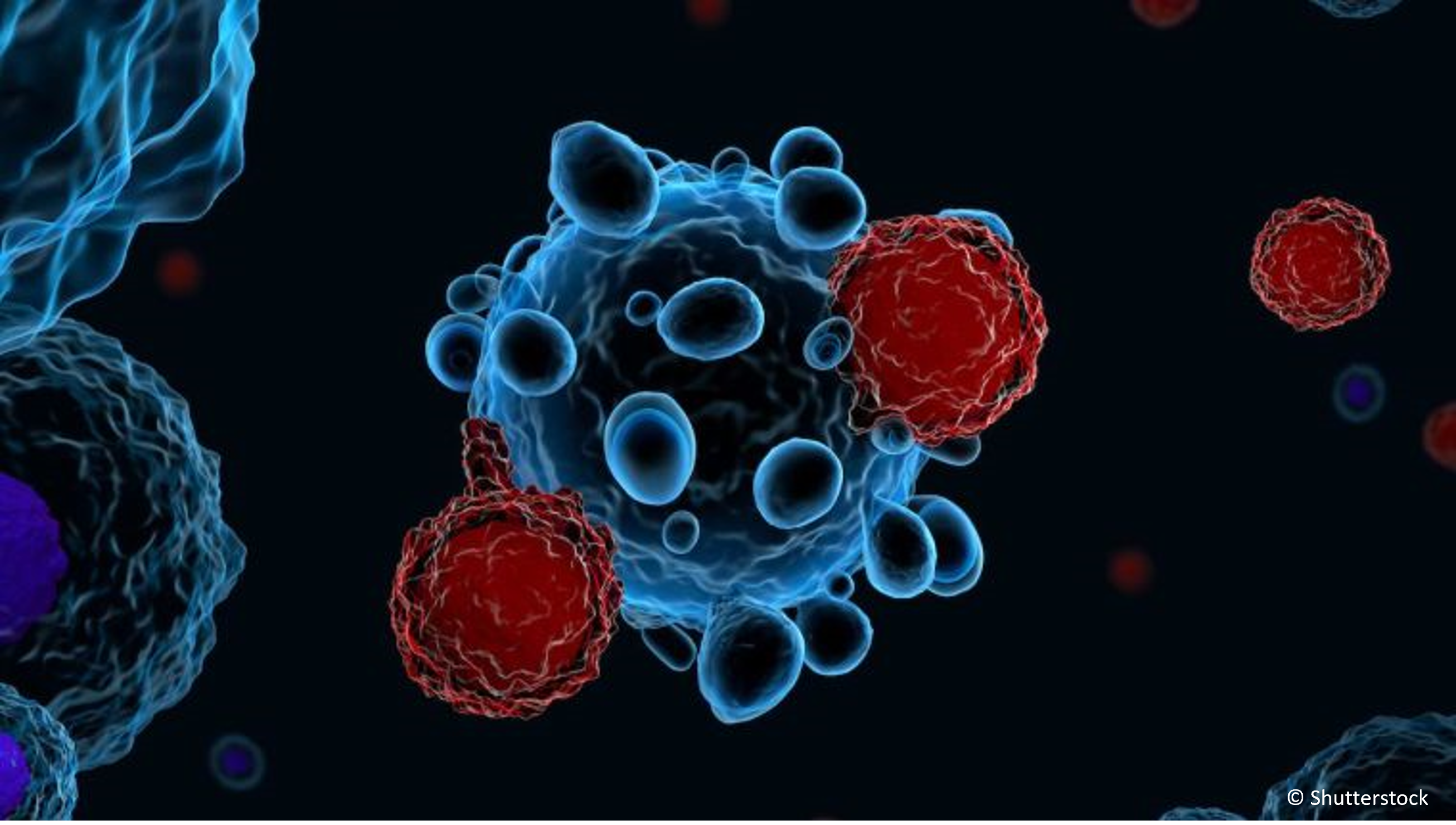
Professor Michael Dustin, who is supported by the Kennedy Trust through a Professorship in Molecular Immunology at the Kennedy Institute of Rheumatology, has contributed to a new understanding of the PD-1 axis (programmed death cell) that could help shape ongoing efforts to improve treatments for cancer and autoimmune diseases.
Excessive activation of T cells underlies a range of autoimmune disorders and cancers. Programmed cell death-1 (PD-1) is a protein found on the surface of T cells and can inhibit their activation. When bound to PD-L1 or PD-L2, PD-1 prevents T cell activation and stops excessive immune responses from damaging healthy tissue.
Cancer cells exploit PD-1 to avoid recognition and destruction by the immune system, so PD-1 is an important target for cancer therapeutics. Anti-PD-1 antibodies, such as pembrolizumab and nivolumab, are used successfully as treatments for several types of cancer.
Mechanistically, PD-1 works in opposition to the related protein CD28, another receptor expressed on T cells that promotes T cell activation and survival. While structurally related, PD-1 and CD28 bind different ligands. CD28 pairs up with itself to form a stable homodimer, whereas PD-1 has been thought to operate alone on the surface as a monomer. This difference might be expected to give CD28 the upper hand by 2 to 1.
However, a new study published in Science Immunology, has for the first time shown that PD-1 and its ligands also form homodimers. Unlike CD28, where dimerisation is mediated by interactions in the extracellular domain with formation of a covalent bond, the dimerisation of PD-1 is a consequence of transient A-shaped transmembrane domain interaction, which increases its activity and puts it on a level playing field with CD28 through PD-1’s own team-work.
Lead author Michael Dustin, Kennedy Trust Professor of Molecular Immunology, Kennedy Institute, said: ‘We have been able to show that PD-1 moves over the T cell surface as a homodimer and, using state-of-the-art microscopy at the Kennedy, we show that PD-1 dimerisation helps it inhibit signalling in the immunological synapse, where it meets CD28. Impairing PD-1 dimerisation enhances anti-tumour immunity, but also exacerbates autoimmunity. This knowledge will improve efforts to rewire the immune response for optimal patient outcomes.’
This article was originally published by the Kennedy Institute of Rheumatology.


